

How To Clean Sediment From Hot Water Tank
Written past: Cistron Fitzgerald // Last Updated:
Please note: This page may contain affiliate links. If y'all buy a product or service through such a link nosotros earn a commission at no boosted cost to you. Larn more about our product review procedure or cheque our FTC affiliate disclosure.
H2o softeners are low maintenance for the almost office. However, to ensure that your arrangement continues to run smoothly and at peak performance for years to come, y'all can practise more than just pour new salt into the brine tank every now and then.
Proper water softener maintenance will likewise increase longevity and lower repair costs. And the proficient news is that it'southward simple enough for every homeowner to accept care of.
Want to learn more? The following guide will provide you with everything you need to know.
Contents
- Refilling Salt
- How to drain the brine tank on a water softener
- How to clean a h2o softener
- Cleaning the alkali tank
- Sanitizing – can you put bleach in your water softener?
- Cleaning the resin tank
- How to remove salt bridges
- How to prevent bridging
- Mushing
- Cost
- Maintenance checklist
Refilling Salt
No need to brand things more complicated than they have to be. Simply bank check the salt level of your water softener'southward brine tank in one case a month. Refill when it'due south below the ¼ mark. Don't make full up to more ⅔ to prevent bridging. That's it!
How to Drain the Brine Tank on a Water Softener
Draining a alkali tank is necessary for cleaning, sanitizing and troubleshooting.
Thereby we need to differentiate between pre and mail service-make full h2o softeners:
- A post-fill system will automatically refill its alkali tank at the end of each regeneration wheel. Thus, it always has water or rather brine inside.
- If at that place is no h2o in the brine tank that means that you ain a pre-make full unit and there is no demand to drain it, obviously – at least as long equally it's functioning properly.
That beingness said, there are dissimilar options for how you can drain a post-make full water softener.
For case, y'all could simply scoop the water into a bucket. This manner y'all can pour it dorsum into the tank when you are done cleaning or whatever it is that you are doing. Of form, this only makes sense if the water is not too muddied.
Alternatively, y'all could employ a moisture vacuum. Some other selection would be to start a transmission regeneration cycle. During the brining phase the softener will automatically suck all water out of the alkali tank.
(Depending on your model you can trigger regeneration by pushing and holding the "regenerate"-button. When regen starts, push the button one more than fourth dimension to skip to the brine cycle. Once the alkali tank is empty, skip all other cycles to get dorsum into service.)
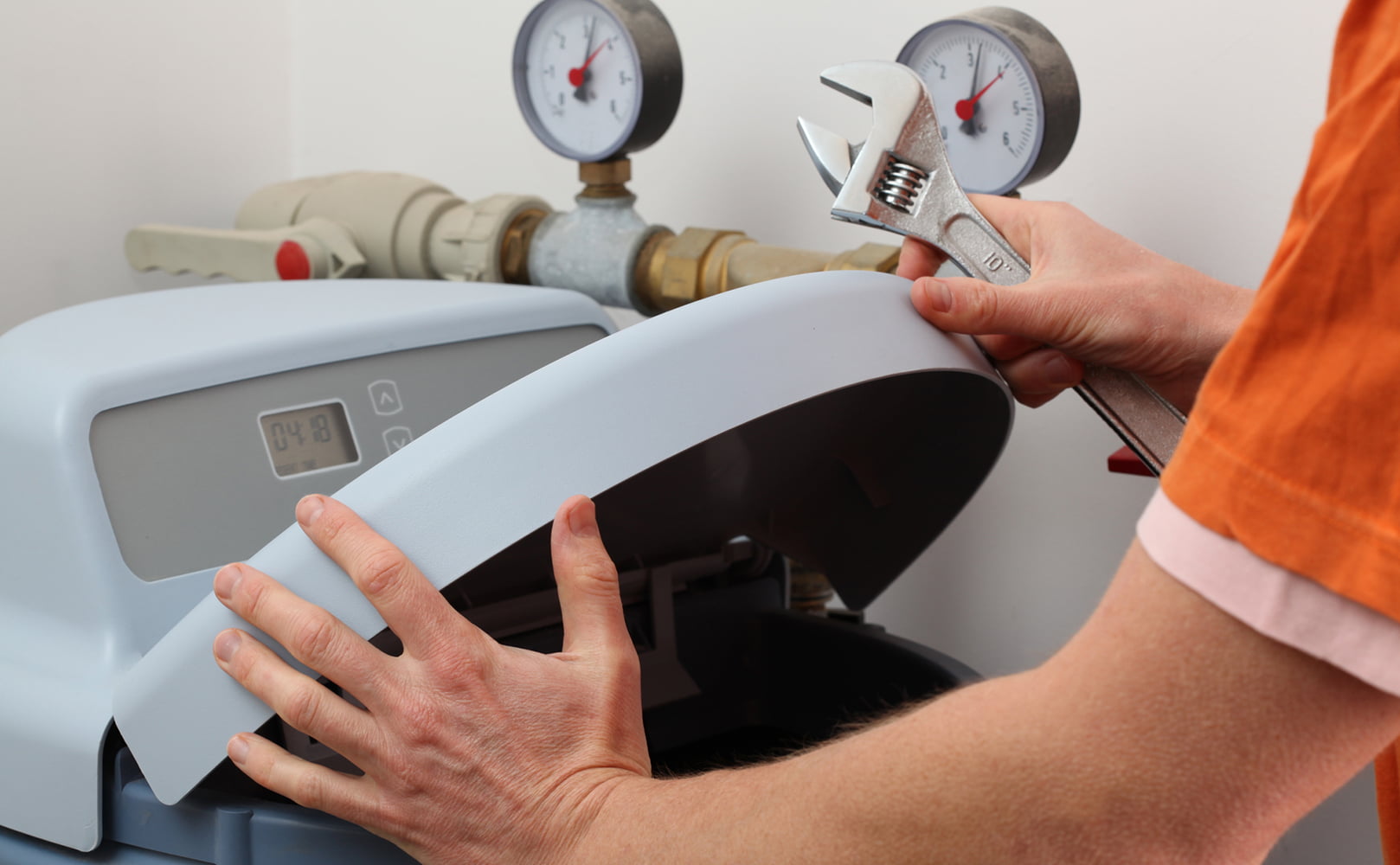
Your last option is to empty all water into an appropriate drain. Before yous movement the tank, however, remember to put your softener into bypass. Then disconnect the fill tube that connects the brine tank to the head valve (for side-by-side softeners only) as well as the brine tank's overflow hose.
If your softener features a salt grid it's a good idea to take it out, likewise. Yous will too need to remove the brine well – that is the extra tube inside the alkali tank that stores the float assembly. Get-go, take out the float. And so dismantle the overflow elbow if there is one and finally pull out the tube.
Now yous tin carefully tip over the tank. But beware that if you empty it on your lawn, the grass volition plough brownish and die.
How to Clean a H2o Softener
A standard h2o softener needs to be cleaned once a year to every five years depending on the circumstances. However, if all of a sudden output water hardness increases or the water is discolored or smells funny, it's definitely a good idea to clean the entire system as soon every bit possible.
Hither is how:
Cleaning the Brine Tank
The all-time time to clean the brine tank is when it has well-nigh run out of salt. This way you don't have to scoop it all out by hand and the tank is lightweight so that you tin motility it effectually for easy access. Maybe you lot even want to accept it outside where you don't have to be super careful almost making a h2o mess.
What's more, when the table salt-level is depression yous can already see whatsoever dirt or mold in the lesser of the tank.
FYI: The dirt is contained in the softening table salt – inexpensive rock salt in particular. Because sediment cannot dissolve it accumulates over time as y'all keep refilling the alkali tank. After a while, the brine might look like sludge. This is the main reason for cleaning: So that the sediment does not clog your organization. It could as well forestall common salt from dissolving properly.
In case the common salt level is nonetheless high and you don't want to wait you will accept to take it out manually. Usually, any salt above the grid plate (if there is i) is worth saving for later on use. Annihilation beneath the plate is garbage.
If y'all ain a post-fill water softener that refills automatically you will also have to drain all water going forrard.
Like we said, there are different options for how you lot can practice this (run across above).
Got rid of all the h2o? Great! The rest of the cleaning procedure looks like this:
- Remove any remaining salt + sludge
- Clean inside
- Add new salt (and water with mail-fill softener)
- Set regeneration cycle for coming night
In case you haven't already taken out the alkali well and common salt filigree at this point, now is the fourth dimension to do so.
To remove whatsoever remaining salt and/or sludge you tin can use a shovel or whichever tool you find suitable. Simply exist careful non to impairment your tank. Once more, a shop vac is groovy for this. If the table salt is too hard to vacuum you can break it loose with a broom handle. And then use a hose to rinse the inside of the tank and vacuum the remaining salt, water and sediment.
For the actual cleaning, mix water with good sometime dishwashing detergent – no need for harsh chemicals – or mold remover if need be and use a brush to exercise some scrubbing. Proceed in heed that in that location is no point in trying to make the tank look make new. And don't forget to rinse thoroughly afterwards.
Pro tip: This is the perfect time to bank check that the float switch is straight and can move freely upwardly and downwardly. Likewise, double-check that it's non plugged so that it can suck in alkali during regen (soak in hot water to unclog).
Once everything is prissy and clean, it'due south time to put the pieces dorsum together and add together new salt, two or iii numberless should do the play a trick on. But showtime, put the brine tank dorsum in place because information technology will exist pretty heavy soon.
Call back that with a post-fill organization you will likewise have to add together about 3 gallons of water. Don't worry, the unit of measurement will adjust its own water level over fourth dimension.
Lastly, set your h2o softener to regenerate the following night and you will exist dorsum in service the adjacent day.
Venturi Valve/Brine Injector Cleaning
Water softeners come with either a venturi valve or a brine injector. Both are responsible for drawing alkali from the brine tank into the resin tank.
Thereby, they brand utilise of a mesh cyberspace or some other type of screen to stop dirt from entering the resin tank. This means that the valve or injector will eventually clog upwards. In other words, whichever you have you lot want to clean information technology out every six months or so.
Now, for every water softener model information technology's going to be different, and then information technology's best if you refer to the transmission.
The components sit somewhere at the back of the head unit of measurement. By and large, you lot offset demand to put your softener into bypass. And then release water pressure by running through a transmission regeneration before opening the encompass/cap.
Sanitizing – Tin Yous Put Bleach in Your H2o Softener?
A h2o softener and its resin in particular can become contaminated with biological organisms like bacteria for different reasons, one being a polluted water supply. But even if your water is disinfected at the source, microbes tin can enter at whatever point before the softening unit of measurement.
Higher up that, atomic number 26, sulfur and other impurities tin promote infestation. Typical signs are a change in colour, foul taste or rotten egg smell in your water. In addition, mildew might class in the brine tank which can besides cause an unpleasant odor.
Newly installed softeners and those that have been out of service for some time or that run for long periods between regenerations are specially affected.
Bottom line: Later the regular cleaning process, yous may want to utilize ii ounces of unscented household bleach mixed with 3 gallons of water to sanitize the brine tank.
Simply allow the solution sit down for nigh 15 to twenty minutes to kill any mold or mildew. Then scrub with a brush. Tip: Focus on the float assembly.
Dump the mixture and rinse carefully with clean water.
Earlier using bleach or any other chemical to sanitize your water softener, read the educational activity transmission for specific hints and restrictions or consult a professional.
Alternatively, what you tin (and should) practice is sanitize the entire system. In fact, some softeners will require periodic disinfection, like every iii to 12 months, during their normal life.
Once more, v.25% sodium hypochlorite (bleach) is commonly all-time suited for this. It can be used with polystyrene resins, zeolite and greensand.
One manufacturer recommends to add together 1.2 fluid ounces – that's less than a quarter cup – per cubic foot polystyrene resin into the brine well earlier/later backwashing the organisation. The bleach will dissolve in the alkali and then be sucked into the resin tank during the brining cycle. Go on with normal regeneration.
Depending on your softener you might also have to add two to 3 gallons of water into the brine tank. This usually entails unplugging the unit of measurement for 20 to xxx minutes during the brining phase to allow all brine to be used up.
For consummate sterilization, the bleach should remain in contact with the resin for at least ane hour.
And to make sure that none of it ends up in the h2o that you lot are later going to use, the resin bed should be rinsed with a minimum of 75 gallons of water per cubic foot. This will also eliminate any disinfection byproducts that may have formed.

three Further Comments:
- Never mix bleach with resin cleaner (see next section). Doing and so may produce potentially harmful fumes. If the latter is already in your salt or brine you have to disconnect the brine line and suck the bleach out of a bucket.
- Chlorine diminishes the softening capacity of the resin bed. Why then apply bleach for sanitization? Because compared to long term chlorination as will be the case for well-nigh municipal supplies and many individual wells, a strong concentration for a very short time will result in minimal impairment. Too, the pros outweigh the cons. Chlorine is one of the most effective and at the same fourth dimension most cheap sanitizers available. When bacteria is present in the resin bed, occasional shocking is the better of the ii evils.
- There are NSF & EPA approved sanitizing products that kill 99.99% of harmful leaner and a broad range of viruses.
Accept you neglected the maintenance of your water softener for too long? Check out our softener reviews if you need a replacement!
Cleaning the Resin Tank
What do yous need to be doing to continue the resin bed in great shape? Not a whole lot in virtually cases, unless your h2o is actually bad.
Municipal water is fine, usually. Well water can be problematic if it contains high amounts of iron or manganese. Both tin can foul the resin, since they are non entirely removed during regeneration.
Besides, accumulation of organic compounds, most unremarkably tannin and humic acids, tin can occur in homes with shallow wells. When these compounds precipitate they become trapped between the resin beads.
In such a example, cleaning a fouled bed with a specialized resin cleaner volition restore softening capacity for reduced salt and h2o usage, prolong resin life, and guarantee that all other organization parts piece of work smoothly as well. Information technology might fifty-fifty aid to amend the gustation of your water and boost flow rates.
How often to make clean? Most experts recommend time intervals of 3 to 12 months, depending on the condition of your water.
Water Softener Resin Cleaners
There are a great number of resin cleaners for y'all to choose from, Iron OUT® beingness the nearly popular for removing atomic number 26 deposits.

Atomic number 26 OUT® – Available on amazon.com
Fe OUT® triggers a chemical reaction that puts iron ions back into solution. The primary reagent is sodium hydrosulfite. Other products might use citric or hydrochloric acid for instance.
Unfortunately, not every iron remover or other specialized cleanser will be suited for your softener and resin. Then you want to find out which ones yous are allowed to use offset. The manufacturer will exist able to provide you with all the necessary data.
Then all you have to do is follow the instructions on the product. Some you dissolve in h2o and pour on top of the salt, others go into the brine well earlier you start a regen cycle. Some are liquid, some dry out. Some need enough of common salt in the brine tank, others can but be used when the common salt level is low.
For some you tin also use a dispenser that you mountain to the side of your brine tank. The dispenser will drip feed half an ounce to one ounce of water softener cleaner into the table salt every day for continuous maintenance. The resin is cleaned with each regeneration and fouling is prevented.
Want to ensure to remove any cleaner residues prior to using the water? Thoroughly flush your softener after regen or run a second bike approx. ii hours after the outset.
How to Remove Common salt Bridges
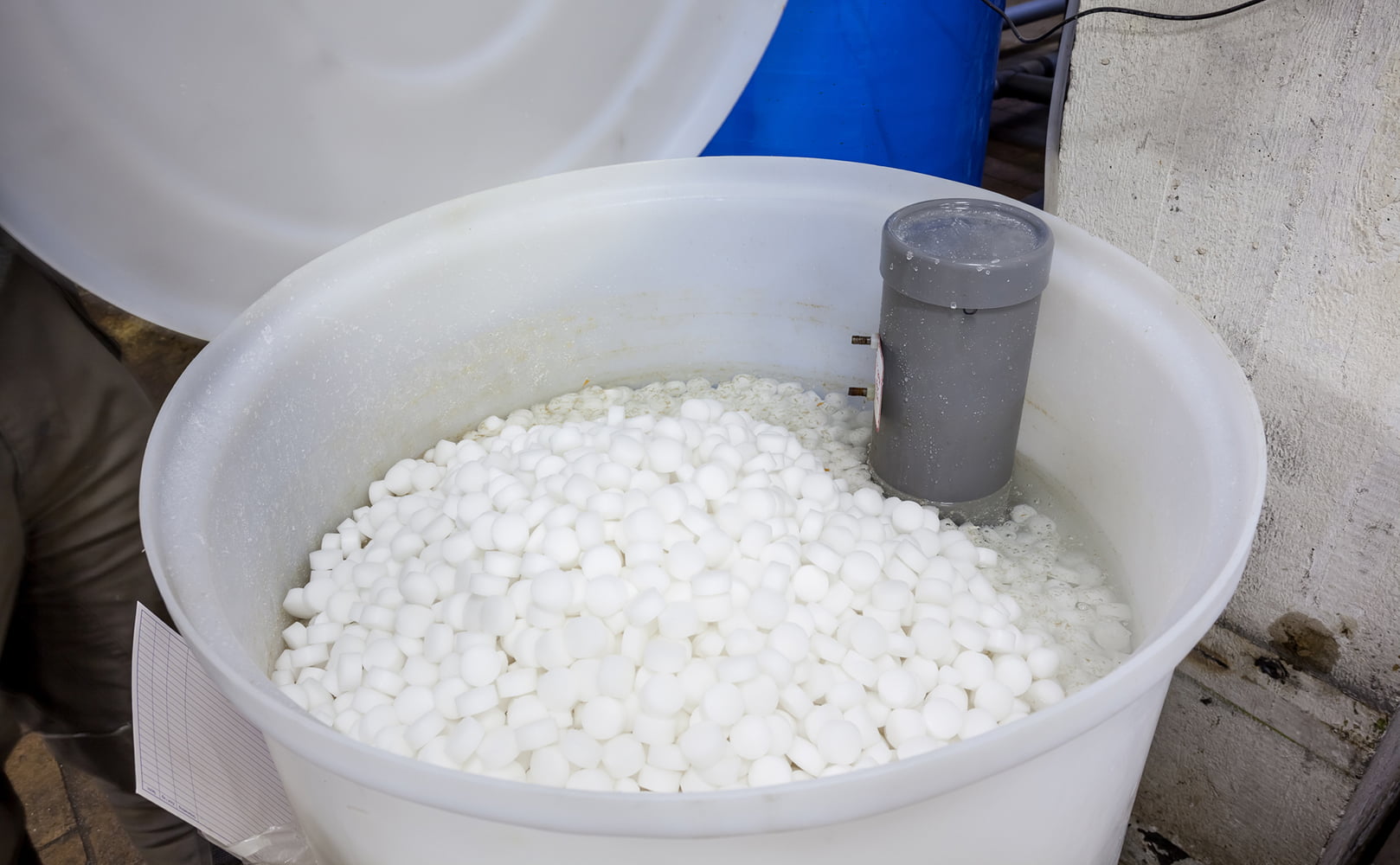
With salt bridging a.1000.a. salt clogging, an encrusted bridge hinders the salt from reaching the bottom of the brine tank and getting in touch with the h2o to form brine. This, in plough, prevents your softener from regenerating properly.
Just to clarify: If a salt span has formed your brine tank might still look like information technology'southward completely filled. However, all salt underneath the span is probably gone. This is why it's of import that you watch out for this phenomenon whenever you refill the tank.
The bad news is that issues with salt bridges have become more common in contempo years. Why? Considering today'south water softeners are much more common salt efficient than they used to be. As a consequence, they use less salt which means that it has more than time to clog. Other reasons for bridging include high air humidity and using the incorrect type of salt (consult the manual to make sure that you're using the right one).
Past the way, the nigh obvious symptom of a salt bridge is that the brine tank salt level is not going down at all. What's more than, hard water might come up out of the system.
You tin can hands test for this by gently hitting on the side of the brine tank to see if it moves or if information technology's really business firm. The latter is an indicator for a salt bridge. What y'all tin can too do is have a broom handle and try to button it all the mode down to the bottom of the tank. If you lot can't and then yous definitely have a bridge.
Be certain to crush whatsoever encrusted salt and large clumps that may have formed. Again, you tin can use a broom handle for this or any other tool that is non too sharp – exist careful non to interruption the salt filigree at the lesser. What you can also do is knock around the side of the tank with a rubber mallet. One time you have eliminated the bridge start a manual regen bicycle.
In more severe cases, loosen and take out equally much salt as you tin can. Then remove all brine that is left in the tank (it has already dissolved as much common salt as it maybe can).
Next, pour 2-3 gallons of warm or hot tap h2o on elevation of the salt. This might already be plenty for the salt bridge to cave. Cascade another ½ gallon into the brine well.
Within the adjacent couple of hours the h2o will offset arresting some of the common salt. Afterwards about 4 to 5 hours yous tin can hit the regen button.
The next solar day, poke around in the brine tank. Has the bridge dissipated? If non, try to loosen up some more than salt and trigger some other regen cycle. You might need to practise this a couple of days in a row.
If you've used the wrong type of common salt in that location is no way around replacing it.
How to Prevent Bridging
A simple rule to preclude common salt from bridging is to fill up your brine tank upward to ⅔ and add no more than common salt until the level is downwardly to about ¼. In humid areas, you should exam adding even less but more often. And you don't want to mix pellets, cubes, crystals or cake salt with ane another.
As long equally you keep doing this you will likely never take problems with salt bridges ever over again.
Mushing
Salt mushing is a dissimilar kind of problem. It occurs when salt dissolves then recrystallizes to course a thick layer of sludge at the base of the brine tank.
Instead of mixing with water, the mush can clog the brine well and cause the water level in the tank to ascent with each regen cycle. Eventually, it will overflow.
To ready this y'all can use the broom handle and effort to break upwardly the mush or scoop it all out. Yous don't necessarily take to discard the salt, specially if it's non overly dirty. Instead, you tin can deliquesce it in hot water and pour information technology back into the brine tank – think recycle.
Cost
If yous prefer not to deal with any of the maintaining yourself yous can hire a company to do it for you lot. Fees for water softener maintenance programs that include monthly salt commitment and arrangement inspection start at $120 USD per year.
For a consummate overview of how much a water softener costs, click here.
Water Softener Maintenance Checklist
This checklist covers basic maintenance tasks that you can do yourself.
General
- Softener is plugged into ability supply
- System is in service fashion unless regenerating
- Optional: Test output water for hardness – provides insights into whether or not system is properly calibrated + functioning correctly; adjust if need be:
- Hardness settings
- Regeneration time of the twenty-four hours, frequency + duration
- Timers
- Common salt settings
- Later power outage: Reset timers
Brine Tank
- Water level is normal
- Table salt level is in a higher place water level; refill if need be (up to ⅔)
- No common salt bridge or mush; remove if need be
- Empty + clean; ready regeneration for coming night (about once a year)
- Float switch is straight + free from salt/clay + can move freely upwardly and downwardly; soak in hot water if need be
- Optional: Sanitize
Resin Tank
- For loftier iron/manganese/tannin levels: Clean resin with resin cleaner (about every 3 to 12 months)
- Optional: Sanitize
Single Parts/Components
- Connections practice not leak
- O-rings are in adept condition; replace if need exist
- Practice featherbed valve to keep it lubricated
- Clean alkali injector/venturi valve (almost every 6 months)
- Optional: Supervene upon pre-filter
Checklist for Download: Checklist.pdf

If you accept any thoughts or questions nearly how to maintain a water softener please don't hesitate to go out a comment below!


Source: https://www.best-osmosis-systems.com/water-softener-maintenance/
Posted by: addisrensell46.blogspot.com
0 Response to "How To Clean Sediment From Hot Water Tank"
Post a Comment